Handjet
Rosetta · David Březina, Ha-neul Park, Lee-su Yoo · 2018
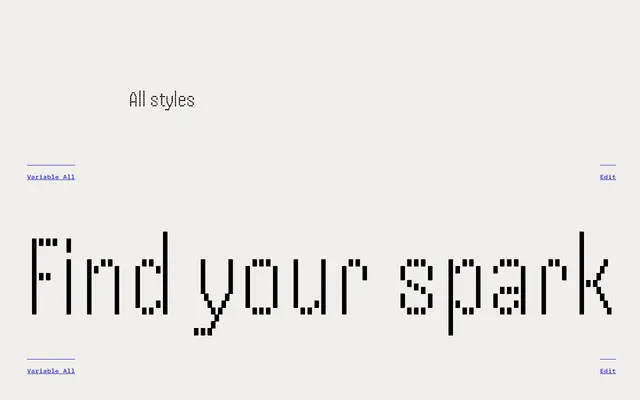
A variable modular typeface built on a 32-pixel dot-matrix grid, originally devised from a student exercise with handjet printers and expanded into a broad multi-script family covering Latin, Cyrillic, Greek, Arabic, Armenian, Hebrew and Hangul.
About
David Březina's Handjet began as a teaching exercise at the Faculty of Fine Arts in Brno, where students built simple element-based fonts for handjet printers in a single day. From that constraint, Březina developed a full variable font system containing 23 elemental shapes — circles, triangles, squares, lozenges, clovers, stars, hearts and more — that interpolate smoothly across a single variable font axis, enabling custom weight and style variations or animations. Google sponsored an extension and open-sourcing in 2019, with consultants adding Arabic, Armenian and Hebrew support; in 2023 Ha-neul Park and Lee-su Yoo extended the system to Hangul with 11,470 new glyphs.
Classification
Built on a 32-pixel vertical matrix derived from handjet printers, Handjet uses discrete geometric elements placed on a grid to form letters, making it a modular display typeface with strong dot-matrix and pixel-art associations.